
![[personal profile]](https://www.dreamwidth.org/img/silk/identity/user.png)


Whitewashed books?
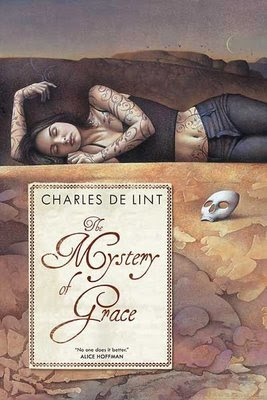
At Millenicon I went over Larry Smith's bookseller table, looking for books by or about people of color. I didn't pull every book out and look at it, just scanned spines and the new book covers on top of the table. The Mystery of Grace, by Charles de Lint, caught my eye because it was pretty, but I was looking for POC, and the character on that cover looked white to me, so I moved on. When I got home, the book was waiting in my mailbox, so I opened it and started reading.
The main character is not white. She is described as being brown. (At least half Mexican though not all her lineage is given in detail).
As far as I can tell, the majority of named, principle characters in this book are either of Mexican descent (brown), or black, or native american. (How they are depicted in the text is a whole other topic, which I won't get into here).
Furthermore, Grace does not have frilly pretty ivy tattoos, she has audacious tattoos of things like portraits of people and saints, and phrases from hotrodding; working on old hotrods is her livelyhood. The book specifically states that she's not into flowery tatoos.
The cover is so wrong with regard to the tatoos, Brian suggested maybe Tor just pulled an illustration they already had and put it on the cover. I don't know. I doubt it.
Earlier at Millenicon I also had a conversation with Jim Hines about this sort of thing. Jim has a principal character in The Stepsister Scheme who is not white, but on the cover illustration that's not illustrated dramatically enough for it to necessarily be obvious, though it is supported by her clothing. He commented that he wonders if he should have pushed harder about that, because the character's color really should be darker.
Then today![[livejournal.com profile]](https://www.dreamwidth.org/img/external/lj-userinfo.gif) oyceter posted about the extreme whitewashing of Angel's Blood, by Nalini Singh (the main character is half-Moroccan and should have "dark gold" skin, but the white hair is canon). I find myself wondering if there are other examples I've never noticed or come across, and what they are.
oyceter posted about the extreme whitewashing of Angel's Blood, by Nalini Singh (the main character is half-Moroccan and should have "dark gold" skin, but the white hair is canon). I find myself wondering if there are other examples I've never noticed or come across, and what they are.
With regard to Grace part of the problem, of course, is that there's no single archetype of "Mexican woman", and while I am frustrated that the woman on the cover doesn't look like, say, my sister-in-law, who lives in Arizona and is of Mexican descent, there are probably at least mixed-race Mexican women she could be an (idealized) portrait of. But still, given that range, there's a choice. Go with something ambiguous, or make her skin brown and her features Mexican (rounder nose... hmm... the difference is hard to describe. Like... um, like this or this). What she looks like, to me, is slightly Spanish. It's not strange for this to seem acceptable, since thanks to Hollywood we often see spanish actresses (see Paz Vega) play mexican characters. One of our most acclaimed Mexican Actresses, Dolores del Rio, in fact came directly from a family of Spanish Basque descent, though she was born in Mexico. And then our sense of what Spanish women look like even gets defrayed as they are played by people like Catherine Zeta Jones, who is Welsh. So what bothers me there is not just a skin-color thing, it's a features thing. Proportions.
And now, if I could really draw, I would start organizing workshops at sf cons about how to draw characters of different racial backgrounds and mixes. I might do that anyway. I just have to study it myself first, or find some artists to support it.
The main character is not white. She is described as being brown. (At least half Mexican though not all her lineage is given in detail).
As far as I can tell, the majority of named, principle characters in this book are either of Mexican descent (brown), or black, or native american. (How they are depicted in the text is a whole other topic, which I won't get into here).
Furthermore, Grace does not have frilly pretty ivy tattoos, she has audacious tattoos of things like portraits of people and saints, and phrases from hotrodding; working on old hotrods is her livelyhood. The book specifically states that she's not into flowery tatoos.
The cover is so wrong with regard to the tatoos, Brian suggested maybe Tor just pulled an illustration they already had and put it on the cover. I don't know. I doubt it.
Earlier at Millenicon I also had a conversation with Jim Hines about this sort of thing. Jim has a principal character in The Stepsister Scheme who is not white, but on the cover illustration that's not illustrated dramatically enough for it to necessarily be obvious, though it is supported by her clothing. He commented that he wonders if he should have pushed harder about that, because the character's color really should be darker.

Then today
oyceter posted about the extreme whitewashing of Angel's Blood, by Nalini Singh (the main character is half-Moroccan and should have "dark gold" skin, but the white hair is canon). I find myself wondering if there are other examples I've never noticed or come across, and what they are.With regard to Grace part of the problem, of course, is that there's no single archetype of "Mexican woman", and while I am frustrated that the woman on the cover doesn't look like, say, my sister-in-law, who lives in Arizona and is of Mexican descent, there are probably at least mixed-race Mexican women she could be an (idealized) portrait of. But still, given that range, there's a choice. Go with something ambiguous, or make her skin brown and her features Mexican (rounder nose... hmm... the difference is hard to describe. Like... um, like this or this). What she looks like, to me, is slightly Spanish. It's not strange for this to seem acceptable, since thanks to Hollywood we often see spanish actresses (see Paz Vega) play mexican characters. One of our most acclaimed Mexican Actresses, Dolores del Rio, in fact came directly from a family of Spanish Basque descent, though she was born in Mexico. And then our sense of what Spanish women look like even gets defrayed as they are played by people like Catherine Zeta Jones, who is Welsh. So what bothers me there is not just a skin-color thing, it's a features thing. Proportions.


And now, if I could really draw, I would start organizing workshops at sf cons about how to draw characters of different racial backgrounds and mixes. I might do that anyway. I just have to study it myself first, or find some artists to support it.
no subject
no subject
no subject
no subject
no subject
no subject
I don't expect to be able to go to Anticipation.
no subject
no subject
no subject
And... horridly I can't remember which one, but I think it was Talia... I also expected one of them to be more curvy/sturdy... ...and for Snow to be a touch more busty. (Though I can see not wanting to fall into the busty/comicbook mold.)
no subject
As for Snow ... yep. I think my comment to the editor was that I REALLY didn't want a "Chain mail bikini babes" cover, but if Snow was showing some cleavage, that would probably be appropriate for her character :-)
no subject
no subject
You and I don't exist in that artwork either. We're invisible between the ages of 20 and 70. And pretty is the rent you pay, for occupying a space marked female. At least in that world, if not everywhere in this one.
In the world of marketing, women are women, and minorities are black or latino or whatever. If the character on the cover is any shade of brown, it means that's what the story is about, and that there's nothing there for anyone who isn't part of that demographic group. And if the character is female, she better be decorative on the cover, because if she isn't, then the book is only for feminists and you won't sell copies to men or non-feminists. If you want to sell a story about an engineer or a soldier, cover art that shows them as brown or female will drown out the soldier vibe or the engineer vibe.
The part of the book marketing world that caters to a more aware audience, has been sidestepping this by not including any pictures of people on the book covers. If a book is aimed at the "Great American Novel" category and hopes to be reviewed as such, then they'll put a landscape on the cover, or abstract art, or a still life. That way they can avoid looking lame for failing to acknowledge diversity, without getting the marketing kiss of death by showing a brown face or an "unattractive" woman.
no subject
Your last two paragraphs seem to imply that perhaps the illustrators are not familiar with how to draw characters of different racial backgrounds because of these examples of "whitewashing" that you have mentioned. I am sure that is true in some cases, but I think, having seen the process of how the illustrator often gets the information, that it is not really the case.
I think for the most part, the illustrator has to deal with the art director, and not with the author directly. I know that my Ex was thrilled when he was able to speak directly to an author, to show sketches, and to try to match up what the author had in mind for a character or scene. But that was a rarity. Also, the illustrator might not have the time/interest/ or even the opportunity to read the text that he is illustrating... it might not be available to him. He must simply work on the imagery based on the art director's description, which could be just a couple of sentences.
Working with art directors can be frustrating for illustrators, as they try to create a rich visual image based on a few words. And those few words may not come from the author and may be incomplete for what is needed for a proper depiction of the text, unfortunately.
I have heard many frustrated illustrators talk about the descriptions given that are more focused on the scene or the action, and after sketches come in for approval, some major detail needs to be altered, like the race, size or even the sex of the character. My ex had almost finished a piece for a book when the AD told him that one of his characters needed to be entirely changed to a female (a female alien, but still a big change, lol). Sometimes it seems like the old telephone game, where the idea travels through so many people, that when it gets to the end of the line, its a totally different thing entirely. And sometimes it gets published that way, if there is enough bureaucracy and not enough checking.
I think having art workshops at Cons is a great idea, and i love the idea of having art workshops celebrating the diversity in humanity! But I just wanted to make a note here that the blame for the "whitewashing" of book covers is not often likely to be placed in the hands of the illustrators.
no subject
Basically that sort of thing.
Re: Art directors: YES. But just because the system sucks and caters to major book buyers and not to readers doesn't mean we just have to throw up our hands and give up. Book buyers and art directors are people too. :)
no subject
no subject
no subject
The publishing industry has holy shibboleths about what on a cover sells books.
no subject
no subject
How much of this exists in SF?
(One of my coworkers was black, and wrote romance novels for a black audience. She was considered fairly groundbreaking. I wonder if there were any differences in how this code applied to her cover art? I don't recall her saying anything about it.)
no subject